 |
| Life in Stalag VII-A We were forced to work at least six days a week - the schedule extended to seven days toward the end of the war. Actually, we looked forward to work details outside the prison walls. Of course, it meant getting out of the barracks, and provided some distraction to brooding about the living conditions and missing home and friends. We also received an extra ration of food when on detail, and the noon and evening meals would always be waiting for us when we returned, even if we didn't get back to camp until after 10:00pm, which happened often as we spent many hours on side tracks waiting for troop or supply trains to pass by. A typical work day meant being rousted at about 5:00am, and reporting for roll call outside in lines of five men. We would often have to stand this way for hours. The German guard who did the counting was not very punctual to begin with and if anybody was missing, chaos and retribution would follow. All the barracks would then be searched by guards and dogs until either the offender was found, or we were recounted and all the prisoners were accounted for.
Forced Labor in Munich Most of our forced labor was done in Munich or nearby Landshut; usually the building or repair of railroad lines. Occasionally, we would pull a detail in the private sector of Munich. One particularly difficult assignment was on the day we were ordered to help clear out a bombed air raid shelter that had been hit by one of our planes the previous night. The shelter revealed a gory mess and I had to help carry out many dead, disfigured civilians. The building must have taken a direct hit and not many occupants could have survived the explosion and fire. The shelter's proximity to the railroad yards had placed it in a dangerous position since the yards were a prime target for our Air Force bombing missions into Germany. We would often work for weeks on a particular stretch of tracks and, as soon as it was useable again, discover the next day that it been bombed by our planes overnight. Despite the efforts put into our repairs, we didn't mind the destruction one bit, because we knew the Germans then couldn't use to their advantage the tracks and roadways we were repairing under duress. Besides, the renewed damage provided more opportunities for us to get into the city to work. We had heard, by the way, that some prisoners were actually paid for the labor they put in for the Germans, but we certainly never were. Nevertheless, we considered our daily work trips into Munich as an
economic benefit. Among other things, we used the city as a means to trade our cigarettes
for bread or meat. While at our work detail location, we would be approached by
black-marketers and ordinary citizens who would ask our guard if anyone had cigarettes to
trade for bread. "Cigareten fur brot? Cigareten fur brot?", they would Occasionally we were watched by, and conversed with, English- speaking children. They would ask us as many questions as we asked them. They told me that English was a required subject in their schools. But, again, we would have to bribe the guard with a cigarette to let the conversation continue. This kind of contact with the locals provided me with one of the most touching conversations I ever had with a German citizen, which, in turn, led to a truly unique situation for Milt and me back at the stalag. I consider the experience to be the highlight of my captivity. |
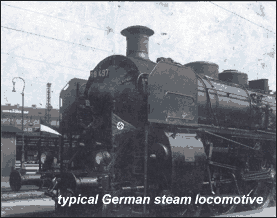 We would usually climb into boxcars by 7:00am. There would
be fifty of us with five guards crammed into one car. The armed guards would sit on a
bench across the open double, sliding doors. There was no seating for us. In fact, we were
packed in so tightly, there was barely room for all of us to sit at once, so some of us
stood during those long rides to and from work. The boxcars, of course, lacked bathroom
facilities, so when we needed to heed the call, we had to ask permission to stand in the
open doorway, hang on to the frame, and water the passing roadway. An interesting personal
experience of mine includes urinating from the train door just before we quickly pulled
into one of many small towns on our route and, as quickly, slowed onto a secondary siding
track to stop. Soon, a German railroad employee who apparently had been standing along the
tracks a few hundred yards back came running up, angrily demanding to know who was
responsible for the horizontal line of wetness across the front of his coat. Thankfully,
he never found out who the culprit really was!
We would usually climb into boxcars by 7:00am. There would
be fifty of us with five guards crammed into one car. The armed guards would sit on a
bench across the open double, sliding doors. There was no seating for us. In fact, we were
packed in so tightly, there was barely room for all of us to sit at once, so some of us
stood during those long rides to and from work. The boxcars, of course, lacked bathroom
facilities, so when we needed to heed the call, we had to ask permission to stand in the
open doorway, hang on to the frame, and water the passing roadway. An interesting personal
experience of mine includes urinating from the train door just before we quickly pulled
into one of many small towns on our route and, as quickly, slowed onto a secondary siding
track to stop. Soon, a German railroad employee who apparently had been standing along the
tracks a few hundred yards back came running up, angrily demanding to know who was
responsible for the horizontal line of wetness across the front of his coat. Thankfully,
he never found out who the culprit really was!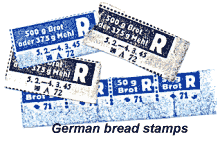 call out.
Before the barter began, we would have to bribe the guard with one or two cigarettes so we
could make the trade. Then the bread itself would cost anywhere from five to ten
cigarettes. Once in a while, we'd get a guard that wouldn't allow trading with the
civilians, but that was rare.
call out.
Before the barter began, we would have to bribe the guard with one or two cigarettes so we
could make the trade. Then the bread itself would cost anywhere from five to ten
cigarettes. Once in a while, we'd get a guard that wouldn't allow trading with the
civilians, but that was rare.